
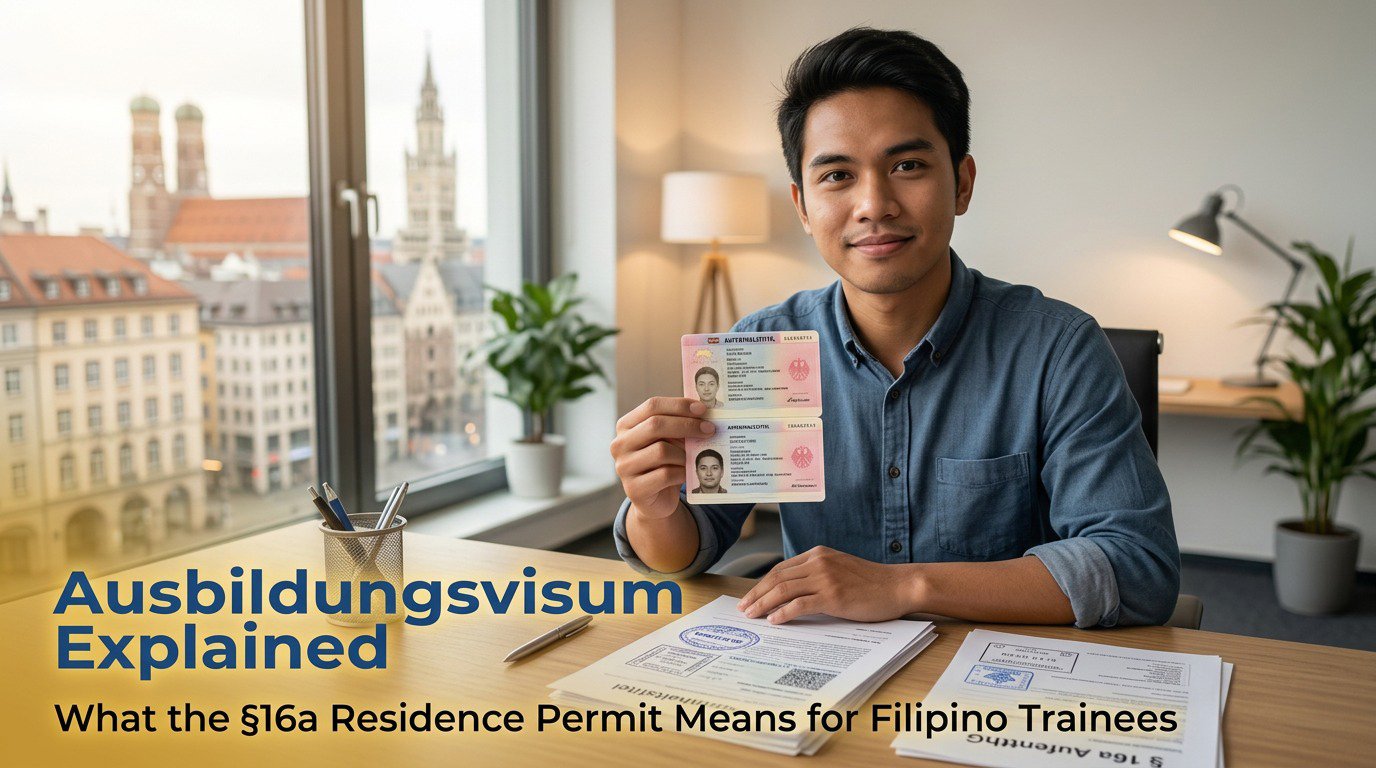
You keep seeing the term ‘§16a’ in articles, visa guides, and embassy websites. But what does it actually mean? Why does the paragraph number matter? And what are the real implications for you as a Filipino applying for an Ausbildung in Germany?
This guide explains the §16a residence permit in plain language — no legal jargon, no confusing German bureaucracy speak. By the end, you will know exactly what rights and responsibilities come with this visa, how it compares to other permit types, and what you can and cannot do while training in Germany under §16a.
What Is §16a? The Legal Background
§16a refers to Section 16a of the German Residence Act (Aufenthaltsgesetz — AufenthG). This is the specific paragraph of German immigration law that governs residence permits for the purpose of vocational training (Berufsausbildung).
When you apply for an Ausbildung visa from the Philippines, you are applying for an Aufenthaltserlaubnis (residence permit) based on §16a. The visa you receive before travelling to Germany is technically a national visa (Type D) — but once you arrive and convert it at the Ausländerbehörde, it becomes a full residence permit under §16a.
What Does the §16a Permit Allow You to Do?
1. Live and Work in Germany During Your Training
The §16a permit allows you to reside legally in Germany for the entire duration of your Ausbildung — typically 2 to 3 years. You are legally employed by your German training company and receive a monthly training salary (Ausbildungsvergütung).
2. Attend Both the Betrieb and the Berufsschule
Your training consists of two components: practical work at your employer (Betrieb) and theoretical lessons at the vocational school (Berufsschule). The §16a permit covers both.
3. Work Part-Time Beyond Your Ausbildung (Up to 10 Hours/Week)
Under §16a, you are permitted to work up to 10 additional hours per week beyond your Ausbildung training hours. This means you can take on a small Nebenjob on the side if you wish.
💡 Pro Tip: The 10-hour rule is a weekly limit, not daily. You can distribute these hours across the week as you like. Many trainees use this extra income to save money or send remittances home.
4. Travel Freely Within the Schengen Area
A §16a residence permit allows you to travel freely within all 27 Schengen countries — including France, Spain, Italy, the Netherlands — without requiring additional visas.
⚠️ Watch Out: Travelling outside the Schengen Area (e.g., back to the Philippines) is allowed, but make sure your permit’s validity covers your return date. Also confirm with your employer how much annual leave you have before booking international trips.
What Does the §16a Permit NOT Allow?
No Self-Employment
Under §16a, you are not permitted to be self-employed or run your own business in Germany. Your residence is tied to your vocational training as an employee.
No Unrestricted Work Outside Your Ausbildung
You can work up to 10 extra hours per week, but you cannot take on a full-time second job or replace your Ausbildung with other employment.
Residence Is Tied to Your Training Program
Your §16a permit is linked to your specific Ausbildung at your specific employer. If you change employers mid-training, you need to notify the Ausländerbehörde and update your permit accordingly.
⚠️ Watch Out: If your Ausbildung contract is terminated, contact the Ausländerbehörde immediately. You have a limited window to find a replacement training position. Do not wait and hope the problem resolves itself.
Duration and Renewal of the §16a Permit
Your §16a residence permit is issued for the full duration of your Ausbildung — typically 2 or 3 years. It may be issued in shorter increments and renewed annually at the local Ausländerbehörde. This is normal.
What Happens When Your Ausbildung Ends?
Option 1 – Job-Seeking Permit (§20): Stay in Germany for 18 months to look for a job in your trained profession. No job offer required.
Option 2 – Skilled Worker Permit (§18a/§18b): If you already have a job offer, apply directly for a skilled worker residence permit based on your new qualification.
§16a and the Path to Permanent Residency
Year 1–3: §16a permit — Ausbildung training
Year 3–5: Skilled worker permit — working in your qualified profession
After 4 years of employment: Eligible for Niederlassungserlaubnis (permanent settlement permit)
After 8 years in Germany: Eligible for German citizenship (Einbürgerung)
💡 Pro Tip: Some highly skilled trainees in shortage occupations (nursing, elderly care) may be eligible for permanent residency after as little as 2 years of employment following their Ausbildung. Ask AusbildungForFilipinos whether your profession qualifies.
§16a vs Other Common Permit Types
§16a – Vocational training: For Ausbildung trainees. Training salary. Duration: 2–3 years.
§16b – Higher education: For university students. Limited part-time work allowed.
§18a – Skilled worker (degree): For university graduates working in their field. Full employment.
§18b – Skilled worker (vocational qual.): For qualified workers with recognized vocational qualifications. Full employment.
§20 – Job-seeking: Temporary permit to search for work after completing education or training.
Practical Tips for Managing Your §16a Permit
- Register your address (Anmeldung) within 14 days of arrival.
- Set a calendar reminder 3 months before your permit expires — renewal appointments need to be booked in advance.
- Notify the Ausländerbehörde of any changes: new address, change of employer, interruption of training.
- Do not exceed the 10-hour part-time work limit.
- Keep all documents related to your training (contract, Berufsschule enrollment, salary slips) for permit renewals.
Frequently Asked Questions About §16a
Q: Can my family join me in Germany while I am on a §16a permit?
A: Family reunion is possible in principle, but it requires proof of adequate income and housing. On a trainee salary, this can be difficult in the early years. Most trainees wait until they have a full skilled worker permit before bringing family members.
Q: Can I travel back to the Philippines during my Ausbildung?
A: Yes. Your annual leave (Urlaub) is set in your training contract — typically 24–30 days per year. Plan any trips back home during your official leave period and coordinate with your employer in advance.
Q: Does the §16a permit give me German health insurance?
A: Yes. As a trainee earning an Ausbildungsvergütung, you are automatically enrolled in the German statutory health insurance (gesetzliche Krankenversicherung). Contributions are shared between you and your employer — typically around 7–8% of your gross salary is deducted from your pay.
Ask Us If You Qualify Under §16a
Not sure whether you meet the requirements for a §16a Ausbildung visa? Our team at AusbildungForFilipinos reviews applications from Filipinos at all stages — from first research to final visa submission. Book a free consultation and get clarity on your eligibility.